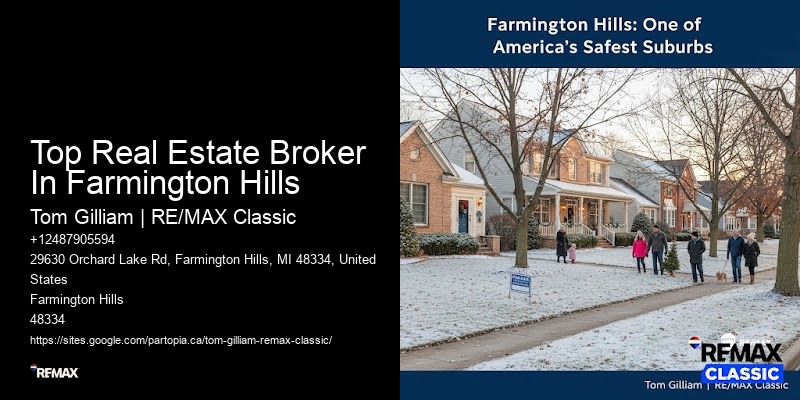
His clients rave about his dedication and the personalized strategies he employs to meet their needs, while his numerous industry awards speak volumes about his professional acumen. You've probably noticed homes in your neighborhood fetching higher prices, and you can thank strategies like Gilliam's for that upward trend. You're not just getting someone who'll list your property; you're partnering with someone who'll work tirelessly to ensure your property is priced right from the start, maximizing your return on investment. Learn more about Top Real Estate Broker In Farmington Hills here From professional photos to targeted online advertising, he uses every tool at his disposal to attract serious buyers. With the right approach, these can be transformed into high-value assets.
Firstly, visit Tom's website to learn more about his services and approach to real estate. Real estate investment club He's not just listing your home; he's telling its story through professional photography, compelling listings, and targeted social media campaigns. Moreover, the economic landscape in Oakland County is thriving. Sellers praise his marketing strategies that get their properties noticed and sold quickly.
Interest rates, for instance, play a pivotal role. Moreover, Tom's personalized approach extends beyond the sale. This document, provided by your lender within three days of your loan application, outlines your expected closing costs. He'll walk you through how he arrived at your home's value, ensuring you're fully informed and confident in the listing price. Learn more about Award-Winning Realtor in Farmington Hills MI here.
It's a dynamic, responsive process that adapts as your search evolves. Understanding what you're willing to concede ahead of time can help you reach an agreement that satisfies both parties. This clarity ensures you don't get swept up in the heat of negotiation and agree to a deal you'll later regret.
Let's explore how Tom Gilliam's approach can simplify the path to homeownership in Farmington Hills, ensuring you're well-equipped to make informed decisions every step of the way. A smart pricing strategy starts with a thorough market analysis. This strategy helps attract more serious buyers quickly, rather than letting properties linger on the market. First off, staging your home is crucial. In addition to his real estate investment guidance, Tom Gilliam offers comprehensive relocation services to assist you in smoothly transitioning to Oakland County.
He's there to provide insights on property potential and pitfalls, helping you envision your life in each space. Interest rates are another critical factor to watch. He guides you through every step of the selling process, from pricing your home competitively to negotiating offers and closing the deal. With over two decades of experience, he's mastered the ins and outs of Farmington Hills' dynamic market.
Misunderstandings can derail negotiations, so it's crucial to ensure both parties are on the same page. One high sale price can lift the values of surrounding homes, creating a positive outcome for the whole community. Real Estate (disambiguation) Gilliam leverages advanced analytics to refine his strategies, ensuring your listing resonates with the right audience.
This not only attracts more potential buyers but also encourages competitive offers, driving up the sale price.


He's on top of every shift, ensuring you're always one step ahead. With over twenty years in the real estate industry, you can trust that Tom Gilliam brings a wealth of experience and knowledge to every transaction. With Tom Gilliam, you're not just selling your home; you're setting yourself up for success in the real estate market. With the market's ebbs and flows, hitting the right note on listing price and making your home stand out can mean the difference between a swift sale and a prolonged market stay.
Understanding your unique needs lies at the heart of Tom Gilliam's approach, ensuring a personalized strategy is crafted for every home sale. With a deep understanding of the local market and a keen eye for what makes a house a perfect match, Tom listens to your needs and preferences to tailor his search just for you. This expertise allows him to advise you on small adjustments that could significantly increase your home's appeal and final selling price.
Whether you're eyeing the market to buy or preparing to list your home, his valuation skills are your ticket to a smoother, more rewarding experience. Read more about Top Real Estate Broker In Farmington Hills here Whether you're searching for a cozy starter home or a sprawling estate, Tom's exclusive listings preview ensures you see the best properties before they're widely advertised. First, you've got to understand the buyer's or seller's position.
First, review the home's asking price against current market conditions. With a vast array of cutting-edge technology at his fingertips, he's equipped to offer you unparalleled insights into the market.
They're the result of Tom's deep understanding of the Farmington Hills market, his ability to accurately price homes, and his commitment to top-notch marketing. Understanding the stress and complexities involved in moving, Tom's approach is tailored to meet your individual needs, ensuring a seamless experience. Moreover, Tom recommends leveraging professional expertise. It's also essential to get pre-approved for a mortgage. Stick around to uncover the secrets behind his success and how they could benefit you, whether you're buying, selling, or simply fascinated by the world of real estate.
During this meeting, Tom will discuss your real estate needs, preferences, and budget.


Tom also coordinates with mortgage lenders, home inspectors, and other professionals to ensure a smooth process. Stay tuned as we unpack the wisdom and predictions from one of Farmington Hills' most seasoned real estate minds, offering you a clearer path in your real estate journey. You'll find him using this insight to advise you on the best time to sell, ensuring you get top dollar for your home. Within a week of partnering with Tom, they'd multiple offers and sold for 15% over their asking price.
Be clear, concise, and articulate your points effectively. You'll benefit from customized marketing strategies that highlight your property's best features, ensuring it reaches the right audience. Farmington Hills offers a diverse range of properties, from charming historic houses to modern constructions, so knowing your priorities is key.
Stay focused on your end goal and maintain a professional demeanor throughout the negotiation process. This attention to detail ensures that when you list your home, it's priced to attract serious buyers while aiming to maximize your return. Maybe it's a quiet evening with a glass of wine on your porch or a small ritual that signifies the start of this new journey. Real estate development
Here, you'll find valuable resources and insights into the Farmington Hills market.
He understands that buying or selling a home isn't just a transaction; it's a life-changing event. Pricing your home right from the start is key. You'll also benefit from Gilliam's network.

 |
The examples and perspective in this article may not represent a worldwide view of the subject. (March 2023)
|
| Property law |
|---|
 |
| Part of the common law series |
| Types |
| Acquisition |
| Estates in land |
| Conveyancing |
| Future use control |
| Nonpossessory interest |
| Related topics |
| Other common law areas |
|
Higher category: Law and Common law |
Real estate is a property consisting of land and the buildings on it, along with its natural resources such as growing crops (e.g. timber), minerals or water, and wild animals; immovable property of this nature; an interest vested in this (also) an item of real property, (more generally) buildings or housing in general.[1][2] In terms of law, real relates to land property and is different from personal property, while estate means the "interest" a person has in that land property.[3]
Real estate is different from personal property, which is not permanently attached to the land (or comes with the land), such as vehicles, boats, jewelry, furniture, tools, and the rolling stock of a farm and farm animals.
In the United States, the transfer, owning, or acquisition of real estate can be through business corporations, individuals, nonprofit corporations, fiduciaries, or any legal entity as seen within the law of each U.S. state.[3]
The natural right of a person to own property as a concept can be seen as having roots in Roman law as well as Greek philosophy.[4] The profession of appraisal can be seen as beginning in England during the 1500s, as agricultural needs required land clearing and land preparation. Textbooks on the subject of surveying began to be written and the term "surveying" was used in England, while the term "appraising" was more used in North America.[5] Natural law which can be seen as "universal law" was discussed among writers of the 15th and 16th century as it pertained to "property theory" and the inter-state relations dealing with foreign investments and the protection of citizens private property abroad. Natural law can be seen as having an influence in Emerich de Vattel's 1758 treatise The Law of Nations which conceptualized the idea of private property.[6]
One of the largest initial real estate deals in history known as the "Louisiana Purchase" happened in 1803 when the Louisiana Purchase Treaty was signed. This treaty paved the way for western expansion and made the U.S. the owners of the "Louisiana Territory" as the land was bought from France for fifteen million dollars, making each acre roughly 4 cents.[7] The oldest real estate brokerage firm was established in 1855 in Chicago, Illinois, and was initially known as "L. D. Olmsted & Co." but is now known as "Baird & Warner".[8] In 1908, the National Association of Realtors was founded in Chicago and in 1916, the name was changed to the National Association of Real Estate Boards and this was also when the term "realtor" was coined to identify real estate professionals.[9]
The stock market crash of 1929 and the Great Depression in the U.S. caused a major drop in real estate worth and prices and ultimately resulted in depreciation of 50% for the four years after 1929.[10] Housing financing in the U.S. was greatly affected by the Banking Act of 1933 and the National Housing Act in 1934 because it allowed for mortgage insurance for home buyers and this system was implemented by the Federal Deposit Insurance as well as the Federal Housing Administration.[11] In 1938, an amendment was made to the National Housing Act and Fannie Mae, a government agency, was established to serve as a secondary market for mortgages and to give lenders more money in order for new homes to be funded.[12]
Title VIII of the Civil Rights Act in the U.S., which is also known as the Fair Housing Act, was put into place in 1968 and dealt with the incorporation of African Americans into neighborhoods as the issues of discrimination were analyzed with the renting, buying, and financing of homes.[13] Internet real estate as a concept began with the first appearance of real estate platforms on the World Wide Web (www) and occurred in 1999.
Residential real estate may contain either a single family or multifamily structure that is available for occupation or for non-business purposes.[14]
Residences can be classified by and how they are connected to neighbouring residences and land. Different types of housing tenure can be used for the same physical type. For example, connected residences might be owned by a single entity and leased out, or owned separately with an agreement covering the relationship between units and common areas and concerns.[15]
According to the Congressional Research Service, in 2021, 65% of homes in the U.S. are owned by the occupier.[16]


Other categories
The size of havelis and chawls is measured in Gaz (square yards), Quila, Marla, Beegha, and acre.
See List of house types for a complete listing of housing types and layouts, real estate trends for shifts in the market, and house or home for more general information.
Real estate can be valued or devalued based on the amount of environmental degradation that has occurred. Environmental degradation can cause extreme health and safety risks. There is a growing demand for the use of site assessments (ESAs) when valuing a property for both private and commercial real estate.[17]
Environmental surveying is made possible by environmental surveyors who examine the environmental factors present within the development of real estate as well as the impacts that development and real estate has on the environment.
Green development is a concept that has grown since the 1970s with the environmental movement and the World Commission on Environment and Development. Green development examines social and environmental impacts with real estate and building. There are 3 areas of focus, being the environmental responsiveness, resource efficiency, and the sensitivity of cultural and societal aspects. Examples of Green development are green infrastructure, LEED, conservation development, and sustainability developments.
Real estate in itself has been measured as a contributing factor to the rise in green house gases. According to the International Energy Agency, real estate in 2019 was responsible for 39 percent of total emissions worldwide and 11 percent of those emissions were due to the manufacturing of materials used in buildings.[18]


Real estate development involves planning and coordinating of housebuilding, real estate construction or renovation projects.[19] Real estate development can be less cyclical than real estate investing.[20]
In markets where land and building prices are rising, real estate is often purchased as an investment, whether or not the owner intends to use the property. Often investment properties are rented out, but "flipping" involves quickly reselling a property, sometimes taking advantage of arbitrage or quickly rising value, and sometimes after repairs are made that substantially raise the value of the property. Luxury real estate is sometimes used as a way to store value, especially by wealthy foreigners, without any particular attempt to rent it out. Some luxury units in London and New York City have been used as a way for corrupt foreign government officials and business people from countries without strong rule of law to launder money or to protect it from seizure.[21] Investment in real estate can be categorized by financial risk into core, value-added, and opportunistic.[22] Real estate value tends to depreciate with age according to hedonic regression.[23]
cite web: CS1 maint: bot: original URL status unknown (link) The dictionary definition of real estate at Wiktionary
 Quotations related to Real estate at Wikiquote
| By owner | |||||
|---|---|---|---|---|---|
| By nature | |||||
| Commons | |||||
| Theory | |||||
| Applications |
|
||||
| Disposession/ redistribution |
|||||
| Scholars (key work) |
|||||
|
|||||
| International | |
|---|---|
| National | |
| Other | |
|
|
The examples and perspective in this article may not represent a worldwide view of the subject. (March 2023)
|
| Property law |
|---|
|
| Part of the common law series |
| Types |
| Acquisition |
| Estates in land |
| Conveyancing |
| Future use control |
| Nonpossessory interest |
| Related topics |
| Other common law areas |
|
Higher category: Law and Common law |
Real estate is a property consisting of land and the buildings on it, along with its natural resources such as growing crops (e.g. timber), minerals or water, and wild animals; immovable property of this nature; an interest vested in this (also) an item of real property, (more generally) buildings or housing in general.[1][2] In terms of law, real relates to land property and is different from personal property, while estate means the "interest" a person has in that land property.[3]
Real estate is different from personal property, which is not permanently attached to the land (or comes with the land), such as vehicles, boats, jewelry, furniture, tools, and the rolling stock of a farm and farm animals.
In the United States, the transfer, owning, or acquisition of real estate can be through business corporations, individuals, nonprofit corporations, fiduciaries, or any legal entity as seen within the law of each U.S. state.[3]
The natural right of a person to own property as a concept can be seen as having roots in Roman law as well as Greek philosophy.[4] The profession of appraisal can be seen as beginning in England during the 1500s, as agricultural needs required land clearing and land preparation. Textbooks on the subject of surveying began to be written and the term "surveying" was used in England, while the term "appraising" was more used in North America.[5] Natural law which can be seen as "universal law" was discussed among writers of the 15th and 16th century as it pertained to "property theory" and the inter-state relations dealing with foreign investments and the protection of citizens private property abroad. Natural law can be seen as having an influence in Emerich de Vattel's 1758 treatise The Law of Nations which conceptualized the idea of private property.[6]
One of the largest initial real estate deals in history known as the "Louisiana Purchase" happened in 1803 when the Louisiana Purchase Treaty was signed. This treaty paved the way for western expansion and made the U.S. the owners of the "Louisiana Territory" as the land was bought from France for fifteen million dollars, making each acre roughly 4 cents.[7] The oldest real estate brokerage firm was established in 1855 in Chicago, Illinois, and was initially known as "L. D. Olmsted & Co." but is now known as "Baird & Warner".[8] In 1908, the National Association of Realtors was founded in Chicago and in 1916, the name was changed to the National Association of Real Estate Boards and this was also when the term "realtor" was coined to identify real estate professionals.[9]
The stock market crash of 1929 and the Great Depression in the U.S. caused a major drop in real estate worth and prices and ultimately resulted in depreciation of 50% for the four years after 1929.[10] Housing financing in the U.S. was greatly affected by the Banking Act of 1933 and the National Housing Act in 1934 because it allowed for mortgage insurance for home buyers and this system was implemented by the Federal Deposit Insurance as well as the Federal Housing Administration.[11] In 1938, an amendment was made to the National Housing Act and Fannie Mae, a government agency, was established to serve as a secondary market for mortgages and to give lenders more money in order for new homes to be funded.[12]
Title VIII of the Civil Rights Act in the U.S., which is also known as the Fair Housing Act, was put into place in 1968 and dealt with the incorporation of African Americans into neighborhoods as the issues of discrimination were analyzed with the renting, buying, and financing of homes.[13] Internet real estate as a concept began with the first appearance of real estate platforms on the World Wide Web (www) and occurred in 1999.
Residential real estate may contain either a single family or multifamily structure that is available for occupation or for non-business purposes.[14]
Residences can be classified by and how they are connected to neighbouring residences and land. Different types of housing tenure can be used for the same physical type. For example, connected residences might be owned by a single entity and leased out, or owned separately with an agreement covering the relationship between units and common areas and concerns.[15]
According to the Congressional Research Service, in 2021, 65% of homes in the U.S. are owned by the occupier.[16]
Other categories
The size of havelis and chawls is measured in Gaz (square yards), Quila, Marla, Beegha, and acre.
See List of house types for a complete listing of housing types and layouts, real estate trends for shifts in the market, and house or home for more general information.
Real estate can be valued or devalued based on the amount of environmental degradation that has occurred. Environmental degradation can cause extreme health and safety risks. There is a growing demand for the use of site assessments (ESAs) when valuing a property for both private and commercial real estate.[17]
Environmental surveying is made possible by environmental surveyors who examine the environmental factors present within the development of real estate as well as the impacts that development and real estate has on the environment.
Green development is a concept that has grown since the 1970s with the environmental movement and the World Commission on Environment and Development. Green development examines social and environmental impacts with real estate and building. There are 3 areas of focus, being the environmental responsiveness, resource efficiency, and the sensitivity of cultural and societal aspects. Examples of Green development are green infrastructure, LEED, conservation development, and sustainability developments.
Real estate in itself has been measured as a contributing factor to the rise in green house gases. According to the International Energy Agency, real estate in 2019 was responsible for 39 percent of total emissions worldwide and 11 percent of those emissions were due to the manufacturing of materials used in buildings.[18]
Real estate development involves planning and coordinating of housebuilding, real estate construction or renovation projects.[19] Real estate development can be less cyclical than real estate investing.[20]
In markets where land and building prices are rising, real estate is often purchased as an investment, whether or not the owner intends to use the property. Often investment properties are rented out, but "flipping" involves quickly reselling a property, sometimes taking advantage of arbitrage or quickly rising value, and sometimes after repairs are made that substantially raise the value of the property. Luxury real estate is sometimes used as a way to store value, especially by wealthy foreigners, without any particular attempt to rent it out. Some luxury units in London and New York City have been used as a way for corrupt foreign government officials and business people from countries without strong rule of law to launder money or to protect it from seizure.[21] Investment in real estate can be categorized by financial risk into core, value-added, and opportunistic.[22] Real estate value tends to depreciate with age according to hedonic regression.[23]
cite web: CS1 maint: bot: original URL status unknown (link) The dictionary definition of real estate at Wiktionary Quotations related to Real estate at Wikiquote| By owner | |||||
|---|---|---|---|---|---|
| By nature | |||||
| Commons | |||||
| Theory | |||||
| Applications |
|
||||
| Disposession/ redistribution |
|||||
| Scholars (key work) |
|||||
|
|||||
| International | |
|---|---|
| National | |
| Other | |


